
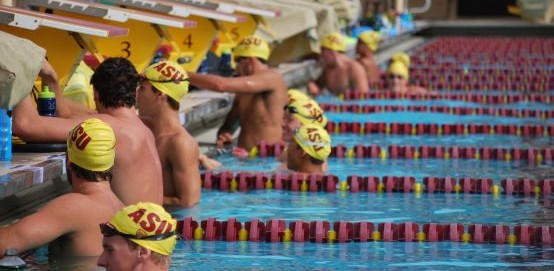

Competitive swimming is a tough sport!
Swimming is a tough sport. It involves a lot of fatigue and long hours. If you compete, you’ll be exposed to lots of pressure, which sometimes lead to short career.
I swam competitively from when I was seven on, competing all the way through the college. At twenty-two, I still enjoy the sport more than most, and I’ve picked up on a few trends amongst those who swam as long or longer than I.
The title is a bit misleading. Pursuing a long career isn’t worth much if you don’t love it year over year. Below I’ll give some tips on loving swimming enough to do it for as long as you want.
7 keys to a long swim career
1. Have Fun. Basically, all the tips below are downstream of having fun. If you were trying to predict the length of the careers of swimmers from a young age, I’d always bet on the one that’s having the most fun. The same principle applies to success in any domain. The ones who are having fun will often stumble on success.
I deeply believe that swimming, by default, is fun. If I had to guess, if you strip away competitive pressures, environmental factors and a few other features, almost anyone can jump into a pool and have fun (given they know how to swim). If you ever find yourself not wanting to go to practice, your north star should be having fun. Find a way to have fun, and you’ll watch many of your problems with the sport simply disappear.
This principle may be self-evident, and probably applies to most sports, but I think it’s important to mention because it tee’s up the rest of our tips.
2. Develop Relationships. Pretty much anything you do is more fun with other people. Suffering through a set with likeminded people is one of the most rewarding experiences you can have. I have been in deep, deep pain during a set, and loved every second of it because I could see my teammates were in the same spot as me.
Teams also help you get through the many “long haul’s” of sport. When the inevitable yearly winter-training comes around, you only need to turn your head and see your teammates in the same place to remind you why you are doing what you are doing.
Make friends with your teammates. Spend time together before and after practice. Nearly all my friends are ex-teammates and I can’t imagine not having them in my life.
Besides your teammates, your coach is the most important person to have a good relationship with. I was blessed with fantastic coaches at each stage of my career. Speak with them often about your goals, what their plan is for you and your team, and what you need to do to improve. The coach-athlete relationship, like all others, is an active one. Don’t forget to put effort in here.
Humans were built to work with others to achieve goals. Harness that trait to make swimming fun.
3. Practice Discipline. Discipline is lauded as a great strength in any career, but it’s worth reviewing why exactly discipline will lead to a long career when so many consider it to be the worst part of swimming.
I do agree that at least at first, and probably intermittently throughout, being disciplined will be the hard part of swimming. Whether its completing a difficult set to the best of your ability, repeatedly doing your mobility routine ahead of practice, or preparing enough good food to perform at your best. There’s no getting around the the repeated steps that will make practicing and competing more fun in the long run.
I think the key thing to rely on is habits. You really can make any behaviour second nature. I can’t promise an 8000 meter set at 5am will be easy, but I can promise you can find a mentality that makes it more than worth it.
The main trick is habits. Most of the stress and hardship of doing difficult things repeatedly is not actually in the act of doing them, but the mental burden of knowing you have to keep doing them. Developing a habit is essentially the process of repeatedly doing that thing over and over, until it is second nature. Once something is second nature, much of the mental burden is alleviated.
Habits, by definition, will be repeated across your whole career. Make them high quality and start as soon as possible.
4. Focus on the Process. Swimming, like most sports, is very goal oriented. We set goals for times, distances, standards and more. An equally important part of swimming is forgetting those goals after a stab at achieving them.
When you don’t have a good race, there are probably some things you can take away from it. A bad turn, a weak finish, dropping your kick in the middle of the pool; the list is usually exhaustive. Despite this, you should probably forget about the race pretty quickly.
Dwelling on a race is one of the worst habits to develop. Swimming is not just a series of meets every few months, it is a lifestyle. Pouring your focus in to thing that already happened, or will happen in the future, will exhaust you. Instead, take the things you need to improve, turn them in to habits, and focus on them. Separate them from the race.
A focus on what you need to accomplish in the next rep, next set, or next hour is as far as your thoughts should stretch because the process is always right in front of you.
5. Don’t do everything at once! One pattern a lot of people fall in to is trying to fix many things at the same time. There’s a couple issues with this. For one, you can’t actually, at any given time, focus on more than one thing at a time. Multitasking is fake. The second issue is that while focusing on 5 things across a practice may feel valuable, you would be a lot better served focusing on one thing for days to months. This is good news because trying to focus on many things at once is very tiring.
Pick something at the start of practice or a new training block and focus on it. It is both easier, more enjoyable and will make you better, quicker.
6. Help Others. This is similar to the earlier point about building relationships. Swimming is a great tool for community building. Your small community of teammates and coaches can be extended to the younger folks on your team, or people of any age looking for a little help in the pool.
If you are early in your career, you may have trouble finding people willing to take your advice. Thats okay, just start with your teammates. A common approach my coaches used was peer review. We’d partner off and take turns doing a turn, start, or half a length of the pool while the other swimmer watched.
This is super valuable because it’s hard to feel or see blind spots in your own technique. In fact, even an experienced swimmer stands to gain from the critique others, including the critique of a less experienced swimmer. Noticing deficiencies and strengths in other’s stroke’s may also fill in gaps you have.
Above all though helping others just feels good. If you feel good around the pool and help build a community, that positivity will leek into your own training.
Culture first!
7. Be Over Appreciative of Critique. verybody has blindspots in their stroke, habits and race plan. If you’re swimming with others, make sure you not only let them give you advice, but go ask for it.
Coaches are eager to give advice but can’t watch every swimmer at once. Ask your coach what they thought of your rep at practice, technique in a swim, or just generally how to get better. Sometimes you have to prompt them to get the conversation going.
Your teammates can also help. A culture of helping each other succeed is essential, and you can start it by asking for help from your teammates. Even swimmers that are slower, or know less than you, can give helpful advice.
Many of the swimmers I trained with wanted advice daily, and they were the best swimmers in the world. Whats your excuse?
The old adage “a happy swimmer is a fast swimmer” is deceptively simple; you can go very far by remembering it.
Christopher Harig was the Arizona State University Swim Team Captain 2023-24, the year ASU won the NCAA Swim Championship and is now a Data Science graduate of the Barrett, the Honors College, Arizona State University. More about Christopher Harig