

Examining Alt-ASFs health benefits☀️
Animal source foods (ASFs), including meat, eggs, fish, and dairy products, provide unique nutritional properties and contribute to healthy diets worldwide. Yet, for a variety of reasons, the dietary landscape has moved somewhat away from ASFs, in favor of Alternative ASFs (Alt-ASFs)—including plant-based, fungi-based, insect-based, algae-based, and cell-based foods—are offered as health-promoting substitutes. A recent scoping review, co-authored by Ty Beal, PhD, published at The Lancet (Nutritional and health impacts of alternative animal source foods) examined the nutritional equivalence and potential health impacts of Alt-ASFs relative to conventional ASFs food systems.
For the review, Alt-ASF is defined as foods made from plants, fungi, algae, tissue culture, single-cell organisms, and insects, with the potential to be consumed as a substitute for conventional ASFs such as meat, eggs, dairy, fish, and seafood,
Ty Beal, PhD, a joint first author of the review, is a Nutrition Scientist | Host of The Ty Beal Show. See Ty Beal, PhD on Linkedin.

Bioavailability and nutrient content considerations
Here are some of the review conclusions:
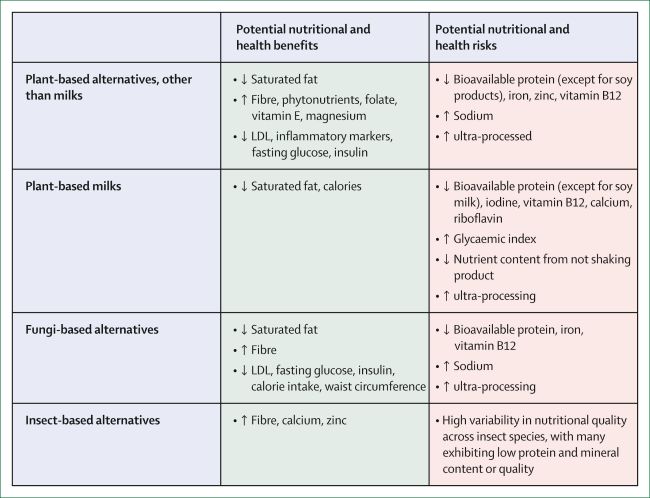
✅Saturated fat, fibre content, calories. Generally, plant-based alternatives generally contain lower saturated fat, higher fibre content, and often fewer calories than their ASF counterparts,
✅Protein content. Plant-based alternatives typically have lower protein content and lower bioavailability.
✅Soy based products. Soy-based products provide protein content similar to that of animal products.
✅Vitamin B12, zinc, and bioavailable iron. Plant-based alternatives typically contain lower levels of vitamin B12, zinc, and bioavailable iron.
✅Folate, magnesium and Vitamin E. Plant-based alternatives typically contain higher levels of some minerals and vitamins like folate, magnesium, and vitamin E.
✅Sodium. Sodium content in plant-based meat alternatives is often higher than that in unprocessed meats.
✅Plant based milk alternatives. Plant-based milk alternatives differ substantially from cow’s milk in nutritional composition. Most plant-based milk alternatives have lower energy density, fat content, and saturated fat content than cow’s milk but typically contain less protein, and the protein quality is generally much lower. Most plant-based milk alternatives contain lower levels of iodine, vitamin B12, calcium, and riboflavin than cow’s milk.
The author (Ralph Teller) believes raw milk is one of the most nutritious natural foods. See Raw Milk Nutrient Content
✅Fungus based foods. Fungi-based foods offer the benefits of higher fibre content and lower total and saturated fat contents, however have higher sodium content and lower levels of protein, iron, and vitamin B12, than their ASF counterparts.
The below chart provides added detailed findings from the review.
Chef James👨🍳 has several delicious natural food duos🥘for peak performance! See Natural Food Duos for Peak Performance.
Takeaway 💪🏻🥛🥚🥩🥦🥬🐟💪🏻
On balance, minimally processed natural foods from plants AND animals provide the basis for an optimally healthy diet!
You’re in control!
More about Ralph Teller