

Music as a metaphor 🎹🪗🎺🎻🪈🥁🎷
Metaphors have long played multiple roles in conceptualizing the mind and brain, guiding the development and refinement of theoretical models and empirical questions.
Researchers have examined the dynamics of music as a metaphor for brain function and “propose music as a scientific metaphor for understanding multiple brain dynamics and cognitive functions“.
Your brain operates as a dynamic ensemble where neural networks synchronize rhythms, anticipate patterns, and improvise solutions in real time. Consciousness emerges from polyphonic coordination across multiple temporal scales simultaneously.
See ScienceDirect Neuroscience & Biobehavioral Review Music as a scientific metaphor for mind and brain.
Here’s what the researchers found 👇
✅Dynamic ensemble. Unlike metaphors focusing on static components or linear flows, music emphasizes continuous adaptation, context-dependence, and cultural embedding, and presents a model for simultaneous engagement with multiple layers of meaning.
✅Music performance and listening. Integrating analytical techniques from music theory and experiential insights from performance and listening, we can deepen our understanding of mind and brain dynamics and provide fresh epistemological pathways for interdisciplinary research.
✅Music temporal complexity. Music has a hierarchical structure, temporal complexity, and capacity to integrate multiple processes that parallel key features of the brain’s architecture and cognitive functions
✅Music rich entanglement of mind and brain. The musical paradigm can capture the rich entanglement of mind and brain, from large-scale brain dynamics and developmental trajectories to the emergence of consciousness and the interplay of affective states.
✅Music helps brain elasticity. Music trains the coordination that determines whether your mind stays flexible or calcifies.
✅Music as a brain training medium. Music can be a training protocol that maintains the neuroplastic capacity everything else depends on.
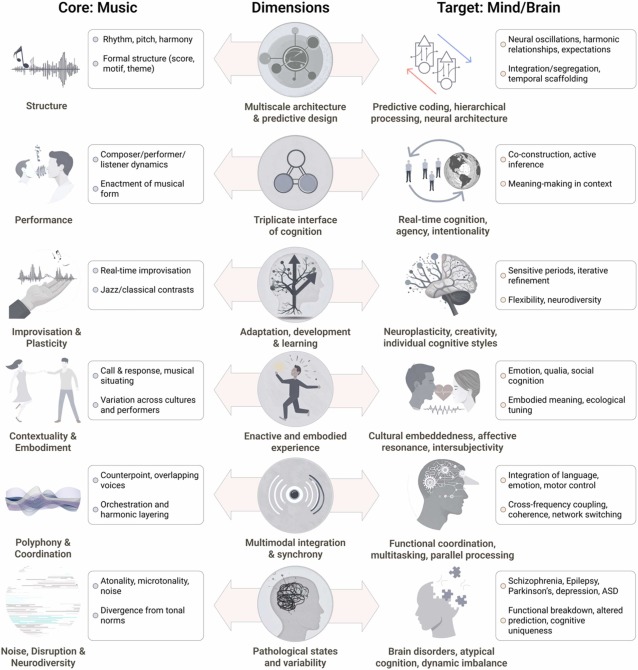
Supporting the global synthesis presented above, the researchers explored and described aspects of cognitive and neuroscientific contexts in terms of the validity of the musical metaphor, captured in the below diagram.
More about Ralph Teller