

Impact of non-protein components
Is red meat good for us or bad for us?
If you’ve been following me for a bit, you probably already know my answer.
➡️ It depends.
The reason why is best explained in pillar 4 of the Precision Protein Framework = The Package.
What is “The Package?”
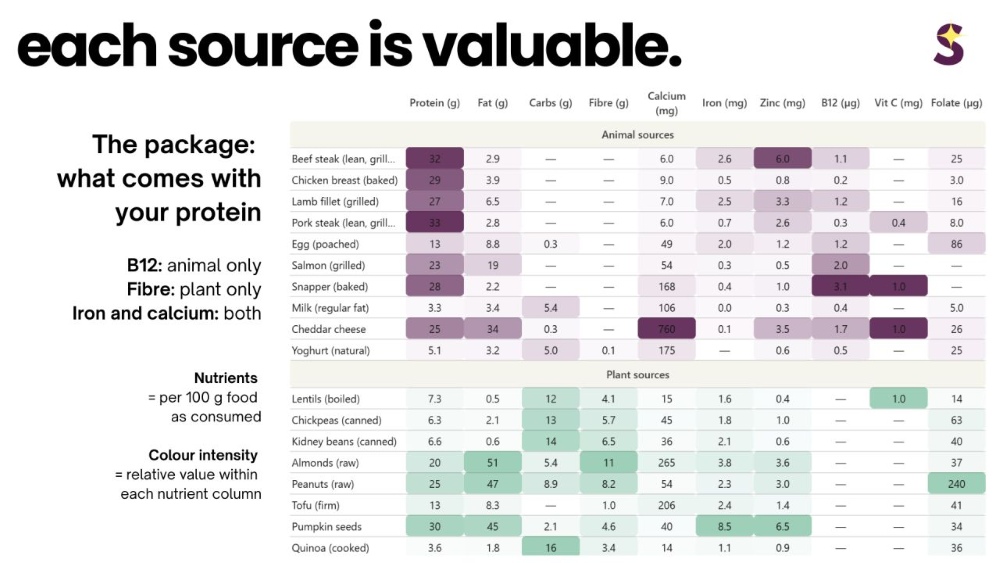
When you eat a protein food, you’re never just eating protein. The Package refers to the non-protein components that come alongside a protein food = fibre, fats, vitamins, minerals, and bioactive compounds.
📊 The attached slide shows this: Look at the massive difference in the micronutrient “package” of beef steak (packed with highly bioavailable iron, zinc, and B12) versus peanuts for example (virtually no B12, but rich in healthy fats, carbs, and folate).
➡️ ➡️ ➡️ This matters, and how it matters is different for every person, every food, every context.
🥩 Red meat illustrates this really well.
The facts:
✅ Red meat has an excellent amino acid profile. High DIAAS, complete essential amino acids, highly digestible.
✅It also contains haem iron, zinc, B12, creatine, and carnitine -> nutrients that are difficult to obtain in meaningful amounts from plant sources.
Case studies
So let’s look at two case studies👇
🙋♀️ Person 1: A young woman with iron deficiency or at risk of it.
For her, red meat isn’t just a protein source. Haem iron is significantly more bioavailable than the non-haem iron in plant foods. The zinc supports immune function, wound healing (and more). The B12 is critical for neurological health and red blood cell production.
So in this context, red meat is hugely valuable -> not necessarily as the only protein source, but we would recommend including it at least a few times per week.
👳♀️ Person 2: A post-menopausal woman with elevated homocysteine levels.
Within its amino acid profile, red meat is notably high in methionine, and methionine metabolism produces homocysteine, which becomes a problem when it accumulates, with evidence of direct damage to blood vessels and circulatory processes. Of course, when things are working as they should, this doesn’t happen, but that depends on genetics, B vitamin status, and overall dietary pattern.
So in this context, we might recommend ensuring red meat is consumed at lower levels, alongside high folate, lower-methionine protein sources such as legumes.
Why the Package matters
💡 This is an illustration of why the package matters and why we cannot just look at one protein source, or one food and put a label on it.
There is no universal answer. There is only the right balance for ‘this’ person, right now.
These conversations are not minor – they need to be a fundamental component of how we talk about and recommend protein.
🔗 The package interacts with quantity, quality, and functionality to determine what is right for a specific person, living a specific life.
Carlene Starck, PhD Metabolic Nutrition Scientist | Translating Nutrition Science into Real-World Impact | Consultant to Health-Focused Brands | Founder, Starck Science
Carlene Starck is from Rotoorangi, Waikato, New Zealand
More about Carlene Starck, PhD
Join Carlene’s mailing list here!
See also Examining Nutrient Bioavailability and Natural Food Duos for Peak Performance and Achieving a Protein Quality Diet