


The role of nitrogen in measuring protein
The “protein” in your food is not just amino acids.
Which means that 20 g on the label is not 20 g amino acids.
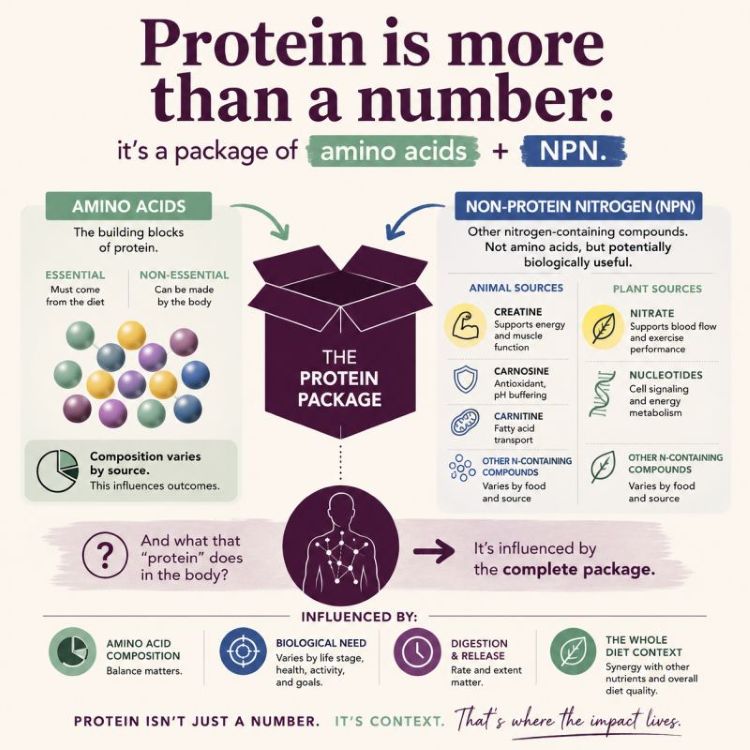
Food protein is commonly estimated from total nitrogen, but total nitrogen isn’t just protein nitrogen. It includes amino-acid nitrogen + non-protein nitrogen (NPN), with the relative contribution varying between foods, particularly between plant and animal sources.
For this reason, different nitrogen to protein conversion factors are used for different foods 👉 they account for both differences in amino acid composition as well as the balance between amino acids and non-protein nitrogen. See Achieving a Protein Quality Diet
So what does this mean for the protein in your diet🥩🥗
✅ Animal and plant protein foods are compositionally different.
✅ Animal protein foods tend to provide higher levels of essential amino acids and have a higher protein quality.
✅ BUT animal and plant protein sources provide their own array of non-protein nitrogen compounds, many of which have biological roles.
NPN is one of the more interesting yet hardly ever talked about aspects of dietary protein, because NPN isn’t “junk nitrogen”.
Creatine and nitrogen
Take creatine in animal foods for example.
Creatine contains nitrogen, but it isn’t an amino acid and it isn’t a protein.
➡️ We can absorb dietary creatine and use it in the creatine/phosphocreatine system involved in cellular energy metabolism.
➡️ Creatine also has an indirect role in supporting muscle growth when combined with resistance training, with emerging research also showing potential benefits for cognitive function (which is why creatine supplementation is experiencing a pretty substantial boom right now).
➡️ In addition, because making creatine relies heavily on methionine, glycine, and arginine, consuming preformed creatine reduces the need to synthesise as much ourselves, potentially sparing some of these amino acids for other metabolic purposes.
🤔 Plant foods do not contain creatine, so 100% plant-based diets rely 100% on endogenous synthesis. Studies have shown significant benefits to cognitive and physical performance in plant-based subjects who supplement with creatine. More about Creatine from Real Food
Plant based foods
But plant foods have their own NPN story: te.g., nitrate.
➡️Dietary nitrate can enter the nitrate → nitrite → nitric oxide pathway and contribute to nitric oxide signalling and vascular function, which can be beneficial for health.
So, all this is great, but what do we do with that 20 g protein label when our primary concern is amino acids?
While food composition databases use different conversion factors for animal vs plant protein foods, partly reflecting differences in protein nitrogen composition and the contribution of NPN, these are not always transferred to nutrition labels, and when they are, not very accurately, which means it is important to consider context:
✅the food source of your protein
✅what you need / are looking for
✅the alignment between the two
Protein is more than a number: it’s a package of amino acids + NPN.
And what that “protein” does in the body? ➡️ Influenced by the complete package.
Carlene Starck, PhD Metabolic Nutrition Scientist | Translating Nutrition Science into Real-World Impact | Consultant to Health-Focused Brands | Founder, Starck Science
Carlene is from Rotoorangi, Waikato, New Zealand
More about Carlene Starck, PhD
Join Carlene’s mailing list here!
#NaturalMedicine #NaturalNutrition #PeakPerformance #Longevity