


Calories and ATP production 🔥
Calories ARE important but….we’re still talking about them like it’s 1890.
I mean, what even IS a calorie? It’s just a measure of heat.
In brief: Burn food in a lab ➡️ measure the heat produced ➡️ we get a number.
Yet the body doesn’t run on heat as a usable energy source.
🔥 It runs on ATP production. ATP (adenosine triphosphate) is the primary energy carrier in cells, providing the energy needed for nearly all cellular processes.
And ATP doesn’t come directly from “calories.” It comes from the metabolism of carbon backbones provided by the food we eat: sugars (from carbs), fatty acids (from fat), and sometimes amino acids (from protein)
Metabolism determines energy use ⚡️
So we need a paradigm shift:
👉 Calories tell you how much potential energy sits inside a food
👉 Metabolism determines how that energy is used
Energy from carbohydrates vs fats
Take carbs vs fat for example.
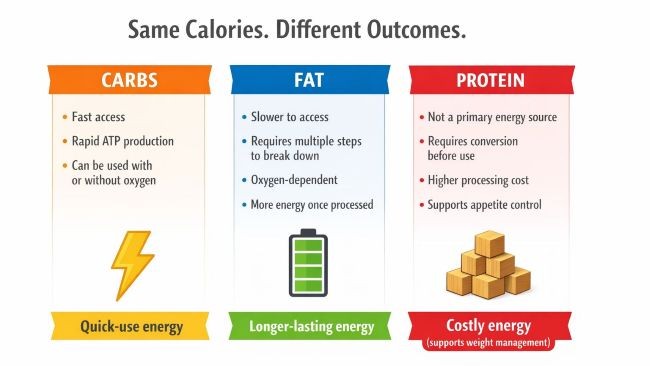
Carbohydrates
➡️relatively simple structure
➡️minimal processing required
➡️rapid entry into energy pathways
➡️doesn’t always need oxygen
➡️fast ATP production
Carbs high-access, high availailability energy.
Vs Fat
➡️more complex structure
➡️requires more steps to break down
➡️takes longer to access
➡️always requires oxygen
➡️but yields more energy once processed
So fats are high-capacity, but slower release energy
Food structure
So, there could be the same “calories” on paper. But have completely different behaviour in the body.
And of course, we also need to take food structure into account e.g., the food matrix, fibre, and digestibility, all of which happens before we get anywhere near ATP production.
Put this together and it is why:
You can eat the same calories but experience completely different energy, hunger, and performance outcomes.
What about protein 🥩
🐺 Well it’s kind of a lone wolf. It sits outside this comparison.
Relying on protein for energy is like burning building materials for heat.
It’s possible and it happens to support energy availability, especially while we sleep, but it’s not the primary intention. Using protein for energy is inefficient (which is partly why it’s great for those who want/need to lose weight).
Takeaway 💪🏻
So instead of asking: “How many calories is this?”
💡 A better approach is: “What kind of energy system do I want to feed?”
Fast access?
High capacity?
Or something inefficient?
Calories are still relevant, and still important.
But without thinking beyond the label, planning a diet around calories is incomplete.
Carlene Starck, PhD Metabolic Nutrition Scientist | Translating Nutrition Science into Real-World Impact | Consultant to Health-Focused Brands | Founder, Starck Science
Carlene is from Rotoorangi, Waikato, New Zealand
More about Carlene Starck, PhD