


Metabolism also listening to light
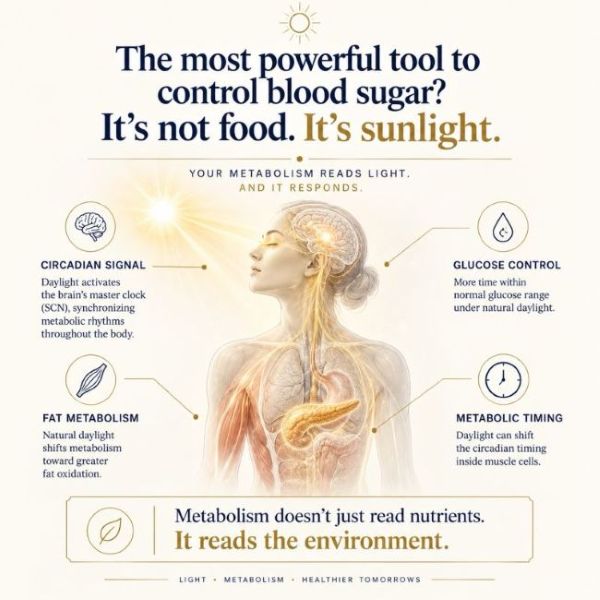
The most powerful tool to control your blood sugar? It’s not your diet. It’s sunlight.
For decades we’ve treated blood glucose as a nutritional problem. Carbohydrates. Protein. Fiber. Meal timing.
What we eat. When we eat. How much we eat.
But emerging biology suggests something much deeper. Our metabolism is also listening to light.
A recent study published in Cell Metabolism tested something remarkably simple. See NIH National Library of Medicine Natural daylight during office hours improves glucose control and whole-body substrate metabolism
People with type 2 diabetes spent several working days under natural daylight and several under artificial office lighting.
Same people. Similar conditions. Different light.
Under natural daylight they spent more time within a normal glucose range. Their metabolism shifted toward greater fat oxidation.
And remarkably even the circadian timing inside their muscle cells changed.
That last part may be the most important because your muscles don’t simply respond to nutrients.
They also run on clocks.
Our molecular machinery follows a 24 hour rhythm
Almost every tissue in your body contains molecular machinery that follows a roughly 24-hour rhythm.
And your metabolism is not operating the same way at every hour of the day.
Light is one of the most powerful environmental signals organizing that timing.
Through the eyes light communicates with the brain’s master circadian clock.
That clock helps synchronize biological rhythms throughout the body👇
✅Glucose regulation.
✅Insulin sensitivity.
✅Fat oxidation.
✅Energy use.
In other words, your metabolism doesn’t only care about what you eat. It also cares about what time your biology thinks it is.
For millions of years that timing was remarkably predictable.
Sunrise meant activity. Bright daylight meant movement and feeding.
Sunset meant the active phase was ending. Darkness meant fasting, recovery and repair.
Food and light were never separate biological signals.
They arrived together.
Today’s inside routine
Today we have separated them. We wake up indoors. Work under artificial light. Eat inside.
Spend most of the day away from sunlight.
Then keep eating and exposing ourselves to light long after sunset.
Our food changed.
But so did the environmental signal telling our metabolism when to use it.
Perhaps that is why the Cell Metabolism findings are so interesting.
Natural daylight didn’t change what the participants ate.
It changed the biological context in which their metabolism received it.
That changes the way we should think about blood sugar.
Because perhaps metabolic health was never only about:
What are you eating?
Perhaps we should also be asking:
What time does your biology think it is when you eat?
For millions of years..
food told us what was entering the body.
Light helped tell us when to use it.
Metabolism doesn’t just read nutrients.
It reads the environment.
Related reading 👉Sunlight Most Powerful Anti-Inflammatory 👉12 Foods that Protect Against Sunburn 👉Infrared Sunlight Health Benefits
Jeoffrey Wisse lives in France.
Jeoffrey Wisse – Co-Founder & CTO NeuraLed | Brain Health & Longevity | Energy | Mitochondria | Light
More about Jeoffrey Wisse
#NaturalMedicine #NaturalHealth #Circadian #Sunlight