


A physiological and metabolic perspective 🍇🍌🍎🍍🍒🍐🥝
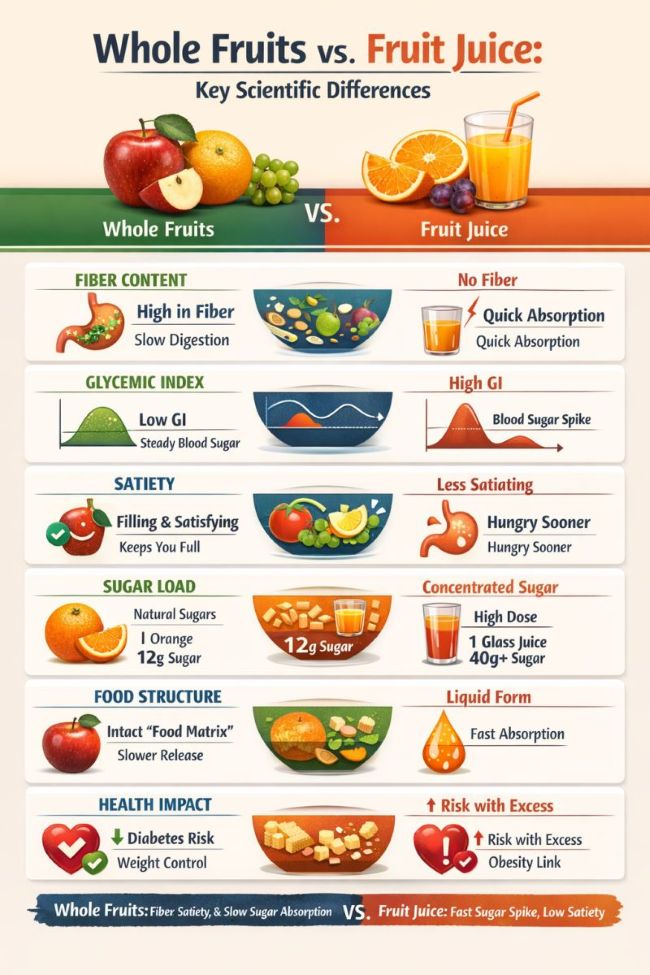
Although derived from the same source, whole fruits and fruit juices elicit distinct metabolic and hormonal responses due to differences in fiber integrity, food matrix structure, and nutrient delivery kinetics.
✅Dietary Fiber & Gastrointestinal Dynamics. Whole fruits contain intact dietary fiber which increases luminal viscosity, delays gastric emptying, and modulates nutrient diffusion across the intestinal epithelium. In contrast, fruit juice lacks this structural fiber, resulting in rapid gastric emptying and accelerated intestinal absorption of sugars.
✅Glycemic Response & Insulin Kinetics. Whole fruit consumption is associated with a lower postprandial glycemic response , due to delayed carbohydrate absorption and reduced glycemic index. Fruit juice, devoid of fiber and structural barriers, leads to rapid glucose appearance in circulation, triggering sharper insulin responses and higher glycemic variability.
✅Satiety Regulation & Gut Hormones, Whole fruits enhance satiety through multiple mechanisms:
a. Mechanical effects of mastication (cephalic phase responses)
b. Delayed gastric emptying
c. Increased secretion of anorexigenic gut hormones such as GLP-1 (glucagon-like peptide-1) and PYY (peptide YY) . Fruit juice, being a liquid with minimal fiber, produces a weaker incretin and satiety hormone response, leading to reduced appetite suppression and earlier return of hunger signals.
✅Energy Density & Consumption Rate. Whole fruits have lower energy density and take time to eat. Juice is energy dense and consumed making it easier to ingest large amounts of calories.
✅Glycemic Load per Serving. Whole fruits naturally limit portion size (you feel full after 1–2 fruits). Juice concentrates multiple fruits into one glass, delivering a much higher glycemic load in a single serving.
✅Food Matrix & Nutrient. Bioaccessibility The intact “food matrix” in whole fruits comprising cell walls, fiber networks, and intracellular compartments regulates nutrient bioaccessibility and digestion kinetics. Juicing disrupts this matrix, increasing bioavailability of free sugars and altering enteroendocrine signaling pathways.
✅Long Term Metabolic Implications. Regular consumption of whole fruits is associated with improved metabolic outcomes, including better weight regulation and reduced cardiometabolic risk. In contrast, frequent intake of fruit juice particularly in excess has been linked to increased caloric intake, reduced satiety signaling, and potential dysregulation of glucose homeostasis.
Monita Gahlot lives in Delhi, India.
Monita Gahlot – Dietician @ All India Institute of Medical Sciences | R.D, Msc. More about Monita Gahlot